
NSW Council for Civil Liberties and Aboriginal Legal Service (NSW/ACT) Call for Overhaul of Minns Government's Organised Crimes Bill
The NSW Council for Civil Liberties (NSWCCL) and Aboriginal Legal Service (NSW/ACT) Limited are deeply concerned by the potential implications of the Crimes and Other Legislation Amendment (Further Organised Crimes Reforms) Bill 2026 (the Bill).
The Bill is presented as a response to organised criminal activity. Though a legitimate public objective, any legislation which seeks to restrict civil liberties must be necessary, proportionate and limited to the purpose of which it was introduced. It also must have appropriate safeguards and oversight. We are concerned that the Bill confers broad and intrusive powers which could extend beyond its stated objectives. This creates a real risk that extraordinary powers introduced for exceptional circumstances may become normalised as ordinary tools of surveillance, and punishment. Moreover, the Bill risks expanding state power at the expense of established rights, including privacy, right to not self-incriminate, and freedom of association.
Our concerns are heightened by the Government's subsequent announcement on 7 September 2026, expanding the definition of 'Serious Children's Indictable Offences'. Subjecting children, whom the Premier admits are victims of exploitation, to adult courts and adult penalties is a regressive step that undermines the youth justice system and fails to address the root causes of systemic crime.
We submit that the NSW Parliament should not pass the Bill in its current form. At minimum, we submit that the most intrusive provisions of the Bill should be withdrawn or substantially amended, and that the Law Enforcement Conduct Commission (LECC) must undertake a mandatory review of the changes made to the Law Enforcement (Powers and Responsibilities) Act 2002 (LEPRA) under the bill.
Without limiting our border concerns, we identify the following areas of specific concern:
Read more
New NSW Bill will lead to tenfold increase in state surveillance and treats everyday commuters as suspects
The NSW Council for Civil Liberties (NSWCCL) condemns a new omnibus bill introduced by NSW Police Minister Yasmin Catley, warning it will significantly expand police powers across three key areas that massively increase state surveillance and treat law-abiding citizens as automated suspects.
The Crimes and Other Legislation Amendment (Further Organised Crimes Reforms) Bill 2026 will strip existing privacy protections to build an unprecedented police surveillance network in NSW. The changes allow NSW Police Force to access to personal mobile devices during routine arrests, roadside stops and other lawful detentions, mandate the automatic upload of millions of driver's licences into a federal facial recognition database, and give police access to high-resolution toll cameras that can see through to the inside of a car to track drivers and passengers.
The NSWCCL warns that the bill’s broad legal definitions cast a dangerously wide net, meaning regular people will be treated as suspects, could have the contents of their phones downloaded with a Cellebrite hacking device, and have their whereabouts tracked by the Police. The lack of appropriate safeguards in this bill means that data could be stored indefinitely and misused.
These proposals, rolled in to supposedly stop organised crime, add to existing conditions of surveillance and searches that NSW residents are already subject to - including NSW Police Drone Surveillance that is set to be rolled out statewide, CCTV towers and aerial surveillance at protests, police knife wanding powers and strip searches.
Together, these measures expand government surveillance tenfold and challenge fundamental human rights of privacy, freedom of movement, freedom of expression, and peaceful assembly.
Read moreSubmission: NSW Human Rights Bill 2025 Inquiry
What the Bill Protects
- Recognition and equality before the law and freedom from discrimination
- Freedom of thought, conscience, religion and belief
- Freedom of opinion and expression
- Right to peaceful assembly and freedom of association.
- Rights of First Nations Peoples
- Right to a clean, healthy and sustainable environment
- Right to a fair trial and rights in criminal proceedings
- Economic, social and cultural rights
No Rights Without Remedy
Submission to the Royal Commission on Antisemitism and Social Cohesion, by NSWCCL and Liberty Victoria
NSWCCL and Liberty Victoria advance four core propositions in our submission to the Royal Commission on Antisemitism and Social Cohesion. .
First, antisemitism is one form of racism and religious intolerance experienced by minority groups in Australia and must be addressed. However, it should not be treated in isolation or elevated above other damaging and pervasive forms of racism and religious intolerance. Antisemitism must be tackled as part of, and not separately to, a broader effort to tackle racism and religious intolerance in Australia.
Second, racism and religious intolerance are complex societal issues that require nuanced solutions. We cannot police or legislate our way to tolerance, respect, or social cohesion. The horrific violence at Bondi, and other instances of hatred based on racism and religious intolerance, demand evidence-based responses that focus on preventative approaches to address drivers of racism.
Third, Liberty Victoria and NSWCCL urge the Royal Commission to take an approach to tackling antisemitism and strengthening social cohesion that is grounded in principles of universal human rights and respect for civil liberties. In particular, we encourage the Royal Commission to focus its recommendations on proactively promoting a vibrant and dynamic democratic society, in which people are encouraged to exchange ideas and participate in robust discussion, debate and protest. Vitally, any restriction on democratic freedoms and human rights should only be recommended where there is a transparent evidence base as justification, and where such restrictions represent the minimum possible intrusion on rights to bring about the stated aims. In particular:
- We urge the Royal Commission to protect the right to protest and free political communication, as fundamental democratic rights. Protest can encompass activities that cause disruption and make some people feel uncomfortable or challenged, and those activities must be protected.
- We caution against the Royal Commission making recommendations which focus on expanding censorship and surveillance, restricting lawful protest and political speech, and expanding the criminal law.
Access to Justice on the Brink with Shocking Cuts to NSW's Legal Safety Net
The Minns Government’s 2026-27 NSW State Budget fails to adequately fund Legal Aid NSW and free legal services, pricing vulnerable citizens out of the justice system. Today’s budget confirms that both State and Federal Labor Governments have chosen to leave some of the state’s most vulnerable without access to justice.
The state budget failure further entrenches the underfunding of organisations like Legal Aid NSW, Community Legal Centres (CLCs), and Aboriginal Legal Service (NSW/ACT) limiting their ability to do their vital work and follows a federal budget that forced Legal Aid NSW to cut Family Law Services and Independent Children's Lawyers.
The state budget also does not meet the growing pressure on private lawyers who deliver legal aid on funding grants. Legal Aid NSW is heavily reliant on private lawyers to deliver services in regional areas, especially in locations where there are no CLCs or Legal Aid NSW services. However, due to dwindling Legal Aid Grants, one in three private lawyers plan to do less legal aid work within the next five years, in which 11% said they will definitely stop doing legal aid work in 2025-26, according to a 2025 Legal Aid Census. If those lawyers stop taking legal aid matters, there is no fallback and the consequences will fall hardest on regional and remote areas.
To avert the collapse of access to justice, the NSW Council for Civil Liberties (NSWCCL) calls on both the Commonwealth and NSW Governments to end legal assistance service cuts and act on four targeted priorities:
Read more
Medical Regulator APHRA Adopts Controversial Definition of Antisemitism
The Australian Health Practitioner Regulation Agency (AHPRA) has announced in a Joint Statement alongside Australia's Special Envoy to Combat Antisemitism Ms Jillian Segal AO that the health practitioner regulator has adopted the International Holocaust Remembrance Alliance (IHRA) definition of antisemitism alongside the Special Envoy's handbook to guide its regulatory work and to ‘ensure a consistent understanding of contemporary antisemitism’.
The NSW Council for Civil Liberties and Liberty Victoria strongly oppose the adoption of the IHRA definition of antisemitism on the basis that doing so would have an unjustified and improper chilling effect on freedom of expression and protest rights, including that it would impede legitimate criticism of Israel and/or the political ideology of Zionism.
The definition has been criticised by human rights NGOs, the UN Special Rapporteur on contemporary forms of racism, racial discrimination, xenophobia and related intolerance, as contributing to violations of human rights. Notably:
-
The original drafter of the definition, Kenneth Stern, has since become a vocal critic on the misuse of the definition, noting that it is being weaponised to stifle free speech. The IHRA working definition is not fit to be the foundation of understanding contemporary antisemitism and should not be adopted by AHPRA.
-
104 civil society organisations, including leading human rights NGOs, have co-signed a letter to the United Nations urging against the use and adoption of the IHRA definition. They stated that: “the UN should ensure that its vital efforts to combat antisemitism do not inadvertently embolden or endorse policies and laws that undermine fundamental human rights, including the right to speak and organize in support of Palestinian rights and to criticize Israeli government policies".
-
11 leading Israeli civil society and human rights NGOs issued a statement in 2023 urging the United Nations against promoting the IHRA definition, stating that the definition ‘is deliberately weaponized to frame legitimate criticisms of Israel’s treatment of the Palestinians as antisemitism’.
NSW Council for Civil Liberties and Liberty Victoria share the concerns that the IHRA working definition is not fit for purpose and is likely to stifle legitimate criticism of Israel and Zionism.
In adopting this definition and the special support material, AHPRA has undermined the fundamental human rights of the practitioners they regulate, and opened the door for the complaints procedures they oversee to be weaponised against those who raise legitimate criticisms of Israel and its treatment of Palestinians.
Read moreJoint Media Release by NSWCCL and CLDC: Civil Liberties Groups Initiate Campaign to Drop the Charges Against Herzog Protesters
"The right to peaceful protest is a cornerstone of any healthy democracy. When police act unlawfully to crack down on a public assembly like we saw on 9 February, the courts cannot be used as an instrument to finish the job. These charges should never have been laid.
Mark Gillespie, a 78er, attended both the 9 February 2026 protest against the visit of Israeli President Herzog and the first Sydney Gay and Lesbian Mardi Gras protest in 1978. Mark said:
"February 9 took me straight back to Kings Cross in June 1978 when we were attacked by police.
"The ferocity and intent to inflict pain on peaceful protesters – there's a commonality there. A real sort of intention to cause pain rather than to disperse a group. That was what I found very ugly.
"We should never have faced that police brutality given 78ers have worked hard with police and commissioners to ensure it would never be repeated."
Media Statement: Labor Revolt Grows over NSW Protest Laws Ahead of State Conference
The right to protest has emerged as the single most submitted issue by Labor branches and affiliated unions ahead of the upcoming NSW Labor Annual Conference in July 2026. A total of 56 motions have been passed by party branches and trade unions across NSW calling for the repeal of anti-protest laws and stronger protections for the right to protest.
Concerns regarding these laws are shared broadly across different factions of the party. Labor MPs including Anthony D’Adam MLC, Cameron Murphy MLC, Stephen Lawrence MLC, Jihad Dib MP and Sarah Kaine MLC have all previously raised concerns regarding the policing of recent demonstrations in NSW.
On Saturday 23 May, Left Faction delegates agreed to prioritise protest rights for the upcoming conference. The motion, previously unanimously endorsed by the Left in March, specifically calls for the repeal of the 2022 Roads and Crimes Legislation and the 2025 Places of Worship legislation.
The push comes after multiple Minns Government protest powers were struck down by the courts, intensifying public and internal pressure on Labor ahead of July’s State Conference. The 56 motions submitted by branches and unions represent the largest coordinated internal pushback against the Minns Government’s protest laws to date.
There are also growing calls from civil society for accountability, including a February open letter signed by 69 organisations calling for an independent inquiry into the use of excessive police force during recent protests. Signatories included faith groups, unions and legal organisations.
Both NSWCCL and Australian Democracy Network (ADN) call on all Labor members, unions, and conference delegates to support these motions and protect the fundamental right to peacefully assemble and march.
Read moreFederal Budget Forces Legal Aid NSW To Cut Funding To Vulnerable Children and Families
The NSW Council for Civil Liberties (NSWCCL) is deeply concerned at the immediate threat to the rights and safety of children and families in the family court system, following a funding crisis forced upon Legal Aid NSW by the latest Federal Budget.
The federal government has cut funding to Legal Aid NSW in real terms by failing to increase legal funding to match the increases in family law services and workloads. Legal Aid NSW yesterday announced that it has been forced to restrict eligibility for its family law representation services to people who had survived family violence or First Nations people (in addition to an assessment of their financial circumstances) in matters of parenting, property, contravention and enforcement, divorce, and drug testing.
These funding cuts mean vulnerable people in our community will not be able to access justice in a complex family law system and directly undermine the rule of law. It will increase the burden on a system already struggling to keep up with demand and further impact the availability of court resources.
The cuts will also result in the elimination of funding for Independent Children’s Lawyers (ICLs) from final hearings where both parents have legal representation. The court is required to consider the wishes and views of children and a final hearing is the precise moment when a court determines what parenting orders are in a child’s best interests and what orders would protect children from harm.
ICLs independently represent children in complex family law proceedings and are a valuable party to parenting proceedings. The funding being pulled from Legal Aid NSW and preventing ICLs to appear at trials will adversely impact the ability for children’s voices to be represented and potentially expose vulnerable parties and children to risks of harm.
Underresourcing Legal Aid NSW means there will be further delays in the system and put strain on the court’s resources. This increase in backlogs in the court drives up legal costs for the entire community, including legally represented parties.
The NSWCCL calls on the NSW Government to reverse Federal cuts in the New South Wales State Budget to be delivered in June 2026. Otherwise, NSW will face an unprecedented breakdown in access to justice.
The NSWCCL calls upon both the Commonwealth and State Attorneys-General to treat this development as an operational emergency and immediately re-negotiate a funding package to restore representation for children and vulnerable families.
Comments attributable to Timothy Roberts, NSWCCL President:
"It is an act of blatant hypocrisy to underfund family law services at Legal Aid at a time when the Commonwealth government has publicly acknowledged the devastating impact of family violence in our communities”.
“The Commonwealth government must urgently provide the required funding to Legal Aid NSW to ensure vulnerable families and children are not exposed to harm. Funding Legal Aid NSW fully and fairly better ensures access to justices and strengthens the rule of law”
“The removal of ICL’s for final hearings in NSW is an alarming recent consequence of chronic underfunding to Legal Aid NSW that increases the risk that children’s voices and wishes will not be appropriately represented.”
“Cuts like these place stress on the family law profession and the court system is a system that is already under-resourced.”
“Legal Aid NSW family lawyers and private family lawyers who assist vulnerable clients on legal aid grants are an essential part of the administration of justice. Without them, thousands of vulnerable members of the community would simply have no meaningful access or representation in the family law system.”
Read moreMedia Statement: NSWCCL Slams Move to Permanently Enshrine Terrifying ASIO Powers
The NSW Council for Civil Liberties (NSWCCL) has called on the Senate to reject the ASIO Amendment Bill (No. 2) 2025, warning that the legislation will create a permanent gap in our civil liberties by removing sunset clauses on extraordinary post-9/11 questioning and detention powers.
The Bill, which passed the lower house and is currently before the Senate, would permanently enshrine powers allowing ASIO to detain and question individuals as young as 14 who are not suspected of any crime. It would remove or restrict accepted legal rights of due process, rights of an accused person to have legal representation and a fair trial.
NSWCCl warns that these powers granted to ASIO are completely disproportionate to the role it should have in our community. This is especially so given the bill further expands the scope for these powers to be used in specific terrorist offences to the much more nebulous ‘politically motivated violence’.
The lack of public and parliamentary scrutiny regarding this legislation is deeply alarming to NSWCCL. In collaboration with Liberty Victoria and Queensland Council for Civil Liberties, NSWCCL had previously made a submission to the review of this bill, and was disappointed to see that our recommendations to repeal these laws, in line with the findings of the Independent National Security Legislation Monitor (INSLM), were largely ignored.
We remind the media and members of the public that the Parliament’s duty is not merely to protect the safety of the public at all costs. It must also preserve the democracy which gives it its legitimacy. We cannot allow any government to use the rhetoric of “combatting extremism” to weaken the protections we have. To do otherwise is to risk allowing the people in Parliament to destroy the very thing they say they are seeking to save.
NSWCCL Celebrates Court of Appeal Ruling Striking Down Government's Anti-protest Laws as Unconstitutional
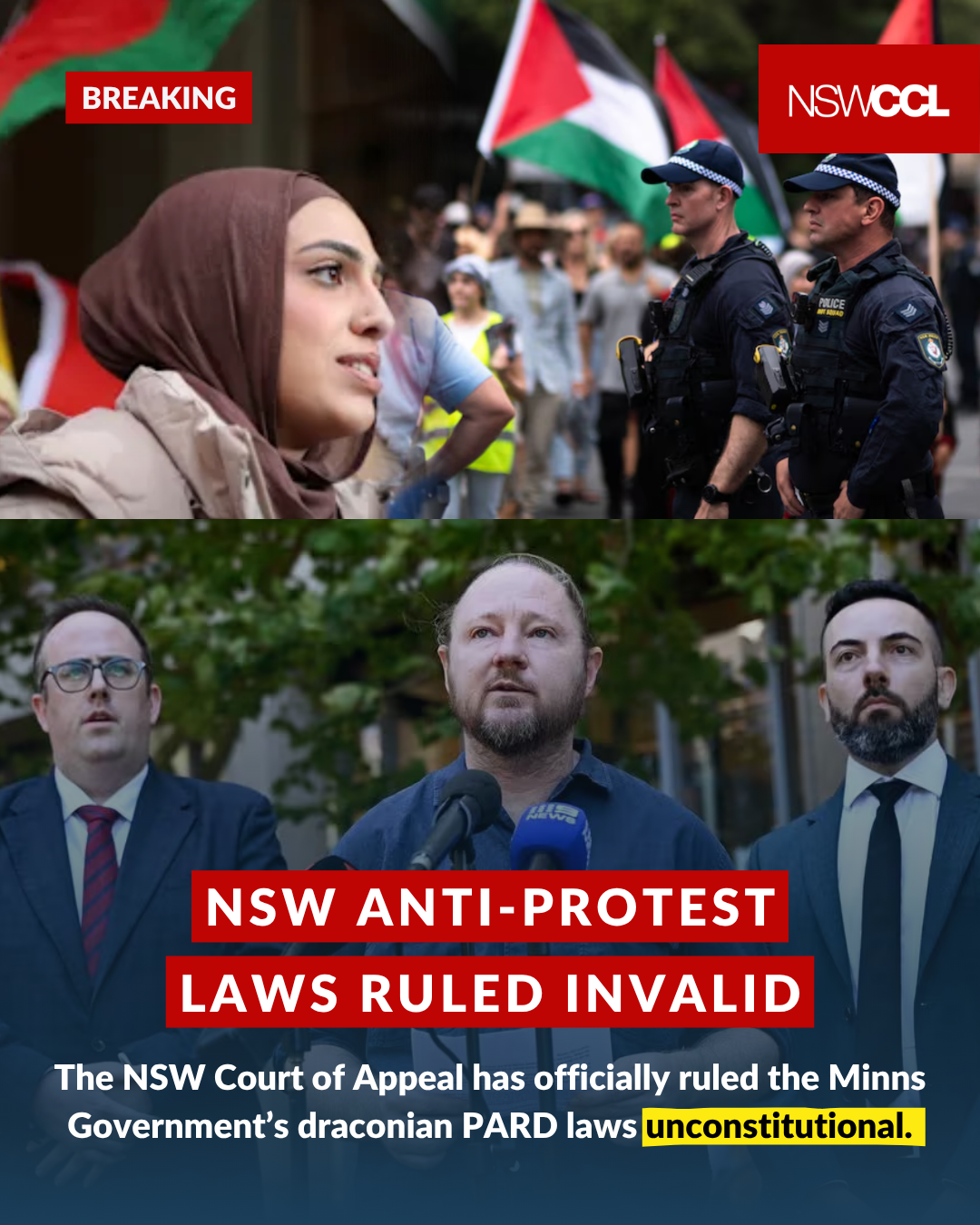
The NSW Council for Civil Liberties (NSWCCL) celebrates the NSW Court of Appeal’s decision to strike down the Public Assembly Restriction Declaration (PARD) powers. This ruling confirms that the Minns Labor Government’s rushed, draconian laws were unconstitutional.
For the past several months, the NSW Government and NSW Police have knowingly wielded unconstitutional powers to harass and silence citizens protesting peacefully. Under the PARD laws, the Police Commissioner was granted unprecedented authority to unilaterally block authorised assemblies with zero transparency. Declarations to ban protests were made with no requirement for community consultation, and bypassed the Form 1 processes originally designed to assist organisations communicate with police when arranging demonstrations.
The government used the horrifying attack against the Jewish community in Bondi to push a repressive agenda against a legitimate right to assembly. They operated under the false premise that social cohesion can be prosecuted into existence and deliberately pursued the chilling effect of these laws that pushed citizens dissenting against unjust governments to the margins, disproportionately affecting First Nations and the Palestine solidarity movement.
Today is a victory. However, the NSWCCL remains alarmed at the blatant attempts of the Minns Labor Government to restrict democratic freedoms. Rushing legislation through under the cloak of night is a hallmark of this government, and without protections like a Human Rights Act in NSW, there is nothing but committed members of the civil society community stopping them from attempting to revive these unconstitutional powers under a different name tomorrow.
Read moreCoalition's Trumpian Immigration Policy is a Frontal Assault on Civil Liberties
The NSWCCL condemns the Coalition’s unveiled immigration policy as a dangerous pivot towards MAGA-style populism and a return to short sighted, small minded, and racist migration policy akin to that of our shameful ‘White Australia Policy” past.
The NSWCCL views the extreme vetting of social media for tourists, making subscription to vague “Australian values” a binding visa condition, and the creation of an "ICE-style" task force, as mirroring some of the most divisive and anti-democratic tactics seen internationally. Proposals to strip legal aid and bypass judicial oversight in migration processes undermines access to justice, and is a departure from the rule of law.
Opposition leader Angus Taylor is moving beyond border security and into disgraceful discrimination by singling out Gazan refugees to be “re-assessed”. This is compounded by the proposed White Australia style "safe country list", designed to fast-track rejections and strip asylum seekers of their right to an individual assessment based on their unique circumstances.
The NSWCCL rejects the Coalition's claim that it battles for “Australian values”. The Coalition’s new immigration policy is not consistent with the values a modern Australia needs to be championing at this time or the leadership it should be showing internationally.NSWCCL Condemns Ban on Iranian Visa Holders as a Dangerous Escalation of Executive Powers
The NSW Council for Civil Liberties (NSWCCL) condemns the Albanese Government’s decision to activate the new ‘arrival control’ powers under the recently passed Migration Amendment Act 2026. This move, which effectively bars over 7,000 Iranian visa holders from entering Australia for the next six months, is a betrayal of human rights that sets a perilous precedent for the exercise of executive power in Australia.
This ban follows only weeks after the government granted humanitarian visas to seven members of the Iranian women’s football team. To embrace high-profile asylum cases while slamming the door on 7,000 others fleeing the same conflict is not humanitarianism - it’s border politics.
The new laws grant the Minister unprecedented discretion to block entire classes of people based on their nationality. Such expansive executive power escapes parliamentary oversight and undermines the core principles of merit based migration.
The government claims the ban is necessary because Iranians are "unlikely" to leave due to the worsening conflict. Yet, Australia is simultaneously committing military personnel and assets to the very regional war that is making the situation worse for civilians.
By preventing travel, the government is deliberately blocking the only practical pathway for many Iranians to reach Australian soil and make an onshore claim for protection - a fundamental human right. The Albanese Government is happy to use the plight of Iranians to justify military involvement, but when those same people seek the safety of their already approved visas, they are treated as a threat to 'migration integrity.' This is a dangerous step toward a system where fundamental rights are subject to the whim of a Minister.
The NSWCCL calls for the immediate revocation of the arrival control determination and for a transparent, rights-based migration process.
Read moreMEDIA STATEMENT: Renewed Calls For NSW Police Commissioner Not to Have PARD Powers
Today the NSW Police Commissioner has again decided to renew the Public Assembly Restriction Declaration (PARD) power for a further 14 days. This power was established in the latest tranche of anti-democratic laws passed by the Minns Labor Government. While a PARD is in effect, Form 1 applications to hold an authorised assembly will not be accepted for the specified policing zones of the declaration.
The NSW Council for Civil Liberties believes this is a disgraceful misuse of power.
Read more
MEDIA STATEMENT: NSWCCL Urges Against Prohibited Hate Groups Legislation
The New South Wales Council for Civil Liberties (NSWCCL) urges parliamentarians to reject the creation of proposed hate organisation powers in the Combatting Antisemitism, Hate and Extremism Bill. This Bill represents an unprecedented extension of executive power and as such has serious potential for misuse. By its broad and vague definitions, concentration of power and lack of procedural fairness the Bill creates a real risk that the powers could be used to inappropriately target groups who work against the political interests of Government, such as protestors or opposing political parties.
The proposed laws represent a very significant risk to freedom of political communication, free speech, and freedom of association. Further, it is fundamental to the rule of law that the law is accessible, intelligible, clear, and predictable. The proposals in the Bill do not meet this basic principle.
If passed, these laws could see a group designated as a hate group, by the actions of one person who happens to be a member of a group (or associated with), even if that person was not actually convicted of a hate crime, or they committed an action that was legal at the time it was committed. This is entirely too vague for the seriousness of the penalties.
Read more
JOINT CCL MEDIA STATEMENT: Federal Government's Approach to Building Community Harmony Will do Real Harm
Today, the Federal Government has unveiled proposed new, broad laws targeting speech and political expression. The Combatting Antisemitism, Hate and Extremism Bill 2026 (Cth) combines practical reforms such as the creation of a National Gun Buyback Scheme with radical and unprecedented reforms to our democratic rights and liberties.
The atrocities at Bondi necessitate a response that will address the causes of violence and increase harmony. The NSW Council for Civil Liberties, Liberty Victoria and Queensland Council for Civil Liberties condemn the proposed Bill due to its remarkable impact on human rights and civil liberties, and because there is no evidence that it will make any of us safer.
Amongst other things, the Bill would create a new framework for “prohibited hate groups”. This would grant the Home Affairs Minister extraordinary powers to designate organisations as “hate groups”, which would effectively make it illegal to be a member of or associated with that organisation. The Bill is also clear that the Minister “is not required to observe any requirements of procedural fairness" in making this decision. This gives the Minister an extraordinary discretion along with a remarkable lack of accountability.
The Bill would also create a new racial vilification offence with a limited defence available if an individual was quoting from or otherwise referencing a religious text for the purpose of “religious teaching or discussion”. There is a risk that offences with selective exclusions or defences might create hierarchies of justice when they are directed to some attributes (such as race) but not others. Any such inequality, perceived or otherwise, only deepens division in the community.
Many measures in the Bill go far beyond what’s required to address the horrific events at Bondi. For example, in relation to displaying symbols offences, the Bill will greatly expand the number of prohibited symbols, reduce the fault element to prove the offence, and place a reverse onus on an accused person to make out a public interest defence. This is in circumstances where the mandatory minimum sentence for the offence is 12 months’ imprisonment. This is highly likely to produce unjust outcomes.
The proposed legislation also expands the government’s already incredibly broad powers to refuse and cancel visas, allowing a person to be excluded based on a risk they “might” engage in certain conduct in Australia like inciting discord. This dangerously lowers the existing threshold into the realm of speculation.
Finally, given the far reaching and consequential nature of the reforms it is particularly concerning that the government has only given two days for stakeholders and civil society to make submissions to the inquiry.
Read moreSubmission: Measures to prohibit slogans that incite hatred
The NSWCCL is concerned about the weaponisation of hatred directed towards vulnerable groups as a political tool to pass legislation which unduly restricts civil liberties. The NSWCCL strongly opposes all forms of hate directed towards vulnerable groups. However, responding to hate in the community must be evidence-based and carefully considered with reference to other fundamental freedoms that are owed to individuals.
It is the NSWCCL’s position that political speech ought to be protected except in circumstances where speech is inciting violence towards a protected group. In any healthy and functioning democracy, it is normal and natural for individuals and/or communities to disagree on political arguments and even in some instances be uncomfortable by the political position of others. Despite this discomfort, it is undemocratic to police political views for the subjective comfort of one group over another.
MEDIA STATEMENT: NSWCCL Calls on NSW Government Not to Proceed with Banning of Slogans
Today, the NSWCCL has made a submission to the NSW Government’s inquiry into measures to prohibit slogans that incite hatred. NSWCCL condemns the decision to allow only four weeks over the Christmas and New Year period for public submissions on such a radical proposal as shamefully anti-democratic and reflects a disregard for principles of transparent and responsible governance.
The NSWCCL is concerned about the weaponisation of hatred directed towards vulnerable groups as a political tool to pass legislation which unduly restricts civil liberties and calls for no further criminalisation of speech or thought to be passed into law in NSW. The criminal law alone is not equipped or designed to achieve social cohesion. It is a reactionary and coercive mechanism that should be reserved for the targeted punishment of harmful conduct, and is not effective when used to encourage broad-brushed social change.
Attempts to restrict the use of “globalise the intifada” are divisive as they target and disproportionately impact the Arabic speaking community, Palestinian community, any others who see the phrase as applicable to the causes that interest them, those supporting these communities or related causes. It does not assist social cohesion for the NSW Government to take up and codify a contested meaning in opposition to these communities. The division caused by doing so is only magnified by the inherent injustice of seeking to suppress a phrase that to many members of the NSW community speaks to fighting oppression.
Read moreMEDIA STATEMENT: NSW Police Commissioner Should Not Have This Power
Today the NSW Police Commissioner has decided to renew the Public Assembly Restriction Declaration (PARD) power for a further 14 days. This power was established in the latest tranche of anti-democratic laws passed by the Minns Labor Government. While a PARD is in effect, Form 1 applications to hold an authorised assembly will not be accepted for the specified policing zones of the declaration.
The NSW Council for Civil Liberties believes this is a disgraceful misuse of power.
Read more
MEDIA STATEMENT: No Justifiable Reason for NSW Police to Extend Public Assembly Restriction Declaration
Tomorrow the NSW Police Commissioner will have to decide whether to renew the Public Assembly Restriction Declaration (PARD) power for a further 14 days. This power was established in the latest tranche of anti-democratic laws passed by the Minns Labor Government. While a PARD is in effect, Form 1 applications to hold an authorised assembly will not be accepted for the specified policing zones of the declaration.
The NSW Council for Civil Liberties is calling on the NSW Police Commissioner not to renew the PARD which is currently in effect in South West Metropolitan, North West Metropolitan and Central Metropolitan policing areas for a further 14 days.
Read more
