
Submission: NSW Department of Education 2020 Code of Conduct Review
The right to free speech and the right to openly participate in political debate are rights which must be available to all residents of NSW whether or not they are employed by the Department of Education. NSWCCL is concerned that the proposed changes to the Code of Conduct by the NSW Department of Education (the Department) has the potential to reduce the civil liberties of Departmental Employees through a restriction on their rights to communicate through personal social media channels.
In this submission the NSWCCL has chosen to concentrate on question 2 in the discussion paper:
2. Where should the department set standards in respect to recognising an employee’s choice to engage with social media but ensuring the reputation of the department and public sector?
In the opinion of the NSWCCL any standards regarding the use of social media by Departmental employees should ensure their right to free speech including the right to participate in political discourse, by not going further than absolutely necessary in limiting such rights.
The proposed social media guidelines should be restricted to matters where an employee is conducting illegal behaviour, such as committing criminal offences, through their speech. No further burden on free speech is necessary for the public interest, nor justified in this context.
Submission: Anti-Discrimination Amendment Bill 2020
NSWCCL submission to the Joint Select Committee Inquiry into the Anti-Discrimination Amendment Bill 2020 - 22 August 2020
The NSW Council for Civil Liberties [NSWCCL] considers it is very important to respond in some detail to this Joint Select Committee’s inquiry into the Anti-Discrimination Amendment (Religious Freedoms and Equality) Bill 2020 [the Bill].
The issues encompassed by this Bill – religious freedoms and protection from discrimination on the grounds of religion - are of great significance in a democracy such as ours. They are also extremely complex and potentially deeply contentious issues. Legislation on human rights must always be carefully considered and balanced, and this is especially so in relation to religious rights and protections. If all rights are not considered in a fair and balanced way the outcome is likely to be discriminatory and harmful to some groups and individuals and to over-privilege the rights of others.
Policy: Human Rights and Technology
2020 NSWCCL AGM
Item 8.3 Policy on Human Rights and Technology
Human Rights and Digital Technology
Australia has experienced an exponential uptake and increased sophistication of surveillance methods, AI informed decision making, and other modern technologies collecting vast amounts of data (Digital Technology). At the same time, laws protecting individuals against breaches of their privacy rights have not kept pace with those technologies. There has been a “drift towards self-regulation in the technology sector, as laws and regulators have not effectively anticipated or responded to new technologies” [1]. While there will always be some degree of regulatory lag with regards to policy design and implementation, capacity-building programs should specifically target policy makers to ensure the development of a policy framework that is remains relevant as technology progresses.
Read morePolicy: ICAC role and funding
2020 NSWCCL AGM
Item 9.2 Policy on ICAC
NSWCCL strongly affirms the crucial role of the Independent Commission Against Corruption in NSW. As Richard Ackland writes, the episode currently playing out with respect to Daryl Maguire, and incidentally, Gladys Berejiklian, is “a timely reminder of the disinfecting sunlight that ICAC is capable of shining”.[1] To quote our President, “while the present proceedings may not encourage federal parliamentarians to move forward more speedily with a federal ICAC, they are certainly encouraging the electors to push for one.”[2]
Read morePolicy: Visa cancellation on character grounds
2020 NSWCCL AGM
Item 8.2 Policy on visa cancellation on character grounds.
Preamble
Section 501 of the Migration Act enables the Minister for Home Affairs or his delegates to cancel the visa or to refuse a visa of any person who is decreed to have failed what is termed ‘the character test’. The grounds on which this can be done are many: they include inter alia serving a total of 12 months’ imprisonment; conviction for any offence, no matter how inconsequential, while in immigration detention; being a person who has been or is a member of a group or organisation, or has had or has an association with a group, organisation or person, and that group, organisation or person has been or is involved in criminal conduct; being a person whose criminal or general conduct is such that the person is not of good character; or having been ordered by a court to participate in a drug rehabilitation scheme. If a court has found a person guilty of an offence against a child, or found a charge against the person proved for an offence against a child, whatever the penalty or even if the person was discharged without a conviction, they fail the character test. Persons can also be found to have failed the character test if there is only a risk that that they may engage in criminal conduct, vilify a section of the Australian community, or incite discord in a section of that community. Harassment, which is defined as including threats to the property of a person, also constitutes a failure of the character test.
Read moreAssange: Extradition hearings, freedom and democracy

The proposed extradition of Julian Assange
The extradition hearing for Julian Assange continues in London. Assange is currently being held in Belmarsh Prison, a category A jail on the outskirts of London, where men convicted of terrorism offences are held. He has limited access to his legal counsel, relegated to sit behind a glass window in the dock. For Assange and his family, the situation is dire.
Read more
2020 Winners NSWCCL Awards for Excellence in Civil Liberties Journalism
Congratulations to the winners of NSWCCL's 2020 Awards for Excellence in Civil Liberties Journalism. The standard of those nominated has been exceptionally high, which made the task of the judges so much more difficult.
From the nominees, the judges named shortlists of 3 in the Young Journalists category and 4 in the Open category. We compliment all entrants on their work and hope that you will continue in similar vein in the future.
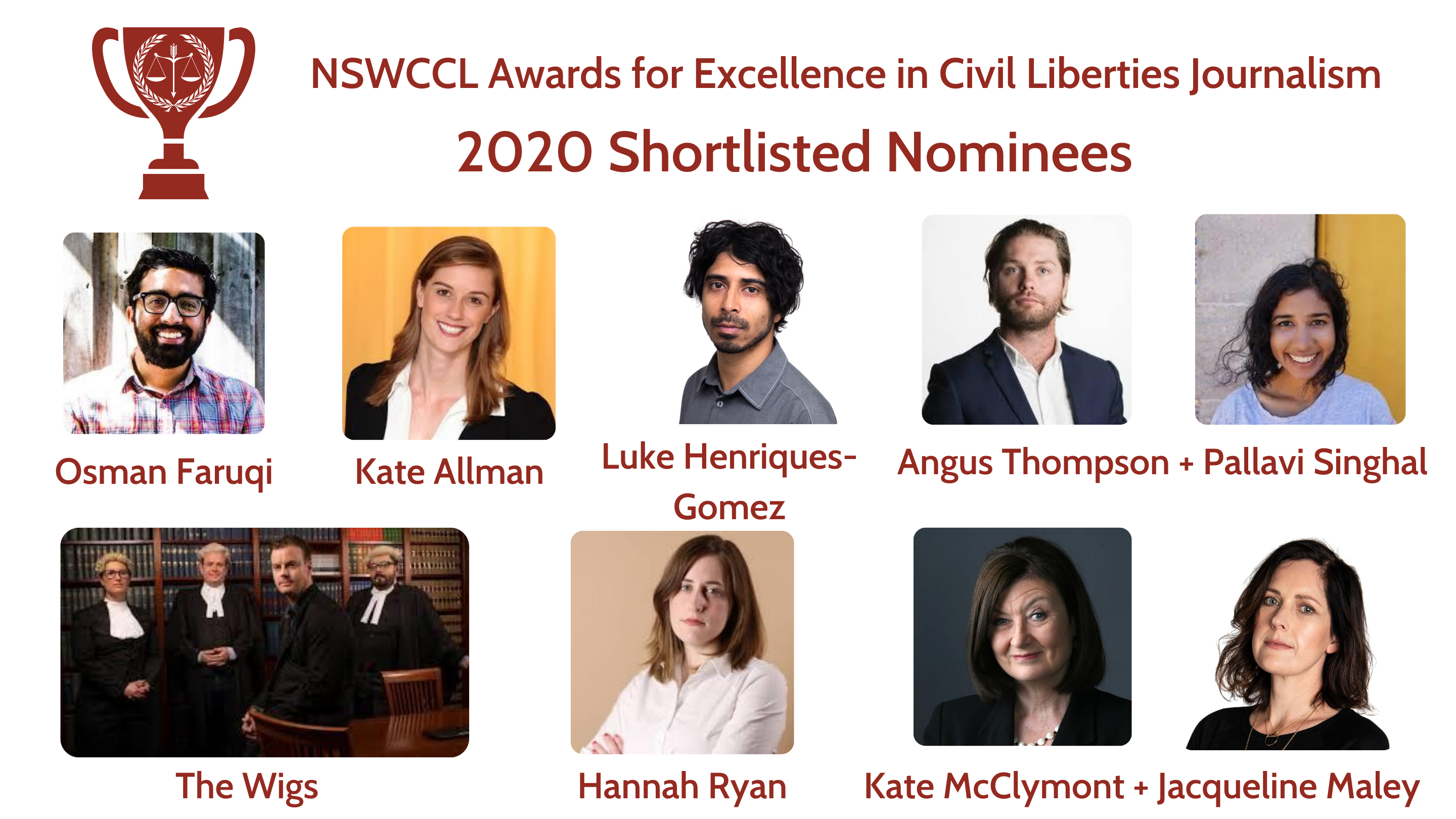
The winner of the Young Journalist's category: Luke Henriques-Gomez of The Guardian for a series of articles on the Robodebt scheme.
 'This young journalist’s articles on the Robodebt debacle exposed federal governmental policy inadequacy and ministerial failure regarding the use of technology and data management in social support programs. They opened a window on current approaches to welfare policy and their failure to observe the principles of democratic governance by being evidence-based and according procedural fairness to affected persons. This failure and indifference led to official cruelty which the articles helped to change by opening up broad debate on the issues raised.'
Congratulations Luke.
The winner of the Open category is shared: Kate McClymont and Jacqueline Maley of the Sydney Morning Herald for their piece on the Dyson Heydon affair.
 'These journalists’ exclusive article on the Dyson Heydon affair demonstrated how deeply entrenched attitudes towards the abuse of women remain in our social and employment structures. They also raised wider critical questions concerning professional transparency, governance and power in the legal profession. This was courageous reporting that was respectful of sources and affirmed freedom of the press in Australia.'
Congratulations to Kate and Jacqueline.
NSWCCL 2020 Fundraiser: First Nations justice webinar
NSWCCL’s online First Nations justice panel discussion was held on 11 September 2020, and featured Judge Myers AM, Sarah Hopkins, Teela Reid and NSWCCL President Nicholas Cowdery AO QC. Our panelists generously shared their knowledge, expertise and heart in speaking about over-incarceration of Indigenous Australians, systemic racism, 'just' policing, the Uluru Statement from the Heart and the black lives matter movement.
The panel discussion was a call to action in relation to the implementation of the recommendations of the ALRC’s report “Pathways to Justice”, including a focus on the crucial need for a commitment to justice reinvestment and specialty courts (such as the Walama Court in NSW).
Read moreSystemic racism and the over-incarceration of Indigenous people must be addressed
8 September 2020
Systemic racism and the over-incarceration of Indigenous people must be addressed.
NSWCCL’s upcoming online panel discussion, on 11 September 2020 at 6:30pm, featuring Judge Myers AM, Sarah Hopkins, Teela Reid and NSWCCL President Nicholas Cowdery AO QC is a call to action in relation to the implementation of the recommendations of the ALRC’s report “Pathways to Justice”, including a focus on the crucial need for a commitment to justice reinvestment and specialty courts (such as the Walama Court in NSW).
In 2018 the Australian Law Reform Commission (ALRC) was asked to consider laws and legal frameworks that contribute to the incarceration rate of Aboriginal and Torres Strait Islander peoples. Aboriginal and Torres Strait Islander adults make up around 2% of the national population, but constitute 27% of the national prison population. The ALRC Report was released in March 2018 and includes 35 recommendations, most of which have simply not been addressed.
His Honour Judge Matthew Myers AM, Commissioner in charge of the ALRC Inquiry, said that while the problems leading to the over-representation of Aboriginal and Torres Strait Islander peoples in prisons are complex, they can be solved,
“Law reform is an important part of that solution. Reduced incarceration, and greater support for Aboriginal and Torres Strait Islander people in contact with the criminal justice system, will improve health, social and economic outcomes for Aboriginal and Torres Strait Islander peoples, and lead to a safer society for all.”
Since 2011 Just Reinvest NSW has been working to support communities to explore and establish justice reinvestment initiatives, including in Bourke, NSW. The focus is to reduce imprisonment rates by directing resources into building strong and safe communities, rather than funding prisons.
Sarah Hopkins, Chair of Just Reinvest NSW, believes that what is required is a shift in the way we view prevention, intervention and justice:
“If we are real about this, what is needed is not just a shift in funding out of prisons and the criminal justice system into crime prevention and early intervention, but a more fundamental shift in power from government to communities, including power over resources. This is about community aspirations and resilience.”
Teela Reid, Wiradjuri and Wailwan woman, lawyer and human rights activist, says that if NSW is serious about protecting civil liberties, then it is time to get very uncomfortable with the status quo.
“The truth is Australia is a colony built on racism, it is written into the laws and operates within its institutions. Systemic racism requires systemic change. If you deny racism exists, then you are part of the problem. This land always was, always will be sovereign Aboriginal and Torres Strait Islander land, sky and sea.”
Ms Reid asks if we are all prepared to confront our own power and privilege to dismantle the systemic racism that continues to oppress. She states that the Uluru Statement from the Heart and the Walama Court ‘are radical attempts to change systems in our search for truth and justice.’
In considering the journey of Australia’s First Nations peoples, NSWCCL President Nicholas Cowdery AO QC believes we need to understand the history of colonialism and dispossession that has led to the disadvantage experienced by Aboriginal and Torres Strait Islander communities. In order to walk with Aboriginal and Torres Strait Islanders ‘in a movement of the Australian people for a better future’ as the Uluru Statement invites, then we also must acknowledge the resilience of Australia’s Aboriginal and Torres Strait Islander peoples.
Mr Cowdery commented:
”Australia’s First Nations peoples constitute the world’s oldest living culture - over 65,000 years. Colonisation took away their land, languages and many traditions and has left them almost without a voice to power. That process has created social disadvantage leading directly to over-representation in prisons around the country.
…This panel will discuss how we reached this disgraceful situation, why now is the time to recognise the resilience of First Nations peoples and to do something about it – and what can be done, drawing upon a huge body of knowledge already assembled.”
2020 has been a challenging year for many individuals and communities. For those who have experienced financial hardship, or are not in a position to pay for a registration, NSWCCL is offering free registration.
“We want to share this important panel discussion with as many of our members and supporters, and beyond, as we can,” says Mr Cowdery.
Registrations - https://www.nswccl.org.au/tickets_2020_nswccl_fundraiser
Free invitation - https://www.nswccl.org.au/invitation_nswccl_2020_panel_discussion
The NSWCCL First Nations Justice panelists:
- Nicholas Cowdery AO, QC, President of the NSWCCL
- Judge Myers AM, lead Commissioner of the ALRC’s inquiry into Incarceration rates of Aboriginal and Torres Strait Islander Peoples
- Sarah Hopkins, Co-Chair of Just Reinvest NSW and the Managing Solicitor of Justice Projects at the Aboriginal Legal Service ACT/NSW
- Teela Reid, Wiradjuri and Wailwan woman, lawyer and human rights activist
The webinar discussion will be held on Friday 11th September at 6:30pm and will be moderated by the 2019 winner of the NSWCCL Award for Excellence in Civil Liberties Journalism, Richard Ackland AM. The 2020 NSWCCL Awards for Excellence in Civil Liberties Journalism will also be announced.
Download this statement as a PDF.
NSWCCL joins public statement opposing NSW One Nation Education Bill
PUBLIC STATEMENT
We represent a vast group of community and civil society partners and leaders in New South Wales (NSW) who place on the public record our strongest opposition to NSW One Nation’s Education Legislation Amendment (Parental Rights) Bill 2020. This legislation, introduced to the NSW Parliament by One Nation’s Mark Latham, aims to outlaw the teaching of gender diversity and the acknowledgement of trans and gender-diverse students and their families and seeks to strip professional accreditation from any teachers and school staff breaking such a law.
Submission: Exemption of delegated legislation from parliamentary oversight
INQUIRY INTO THE EXEMPTION OF DELEGATED LEGISLATION FROM PARLIAMENTARY OVERSIGHT
The New South Wales Council for Civil Liberties welcomes the opportunity to make submissions to the Senate Standing Committee for the Scrutiny of Delegated Legislation with respect to its Inquiry concerning the exemption of delegated legislation from parliamentary oversight.
NSWCCL commends the Committee’s resolve to meet regularly during the recent period of parliamentary adjournment to ensure its continued scrutiny of all delegated legislation, particularly disallowable executive-made COVID-19 instruments. There are significant constraints on the capacity of the Committee to scrutinise particular legislative instruments exempt from parliamentary disallowance, but it is nonetheless performing a very valuable role in flagging ‘framework’ issues.
The Australian government’s response to the COVID-19 crisis has been enabled by the provision of extraordinary powers to Executive Government and Government agencies. This has been achieved largely through the mechanism of determinations under the expansive human biosecurity provisions of the Biosecurity Act 2015 (Cth). As of 6 July 2020, there were 199 specific COVID-19 ‘instruments’ and, of greatest concern, at least 42 of these are not disallowable, denying the Committee the ability to scrutinise them.[1]
The Committee is empowered to scrutinise delegated legislation subject to parliamentary oversight against its 12 technical scrutiny principles (Senate Standing Order 23). These principles include whether the legislation unduly trespasses on personal rights and liberties. However, many of the determinations exempt from parliamentary disallowance are having a significant impact on individual rights and liberties, effectively contain serious offences and impose obligations to do or desist from certain activities. As we understand it, the Committee has no power to scrutinise whether particular pieces of delegated legislation should in fact be disallowable under the current standing orders.
The NSWCCL submission makes 7 recommendations to the Standing Committee.
Statement: Exemptions to Hotel Quarantine, COVID-19
10th July 2020
PUBLIC STATEMENT
NSWCCL has concerns regarding claims that a critically ill man from the New South Wales South Coast has twice been denied an exemption from undergoing hotel quarantine in Sydney, despite medical advice he self-isolate at home.
The ABC reported (8th July) that Stephen Evans, diagnosed with stage four oesophageal cancer in 2018, recently returned from Germany where he had a highly specialised lung procedure. NSW Health has twice refused Mr Evans’ request to self-isolate at home, stating that personal health circumstances must be balanced with ‘the requirement to implement the Public Health (COVID-19 Air Transportation Quarantine) Order 2020’.
Read moreSubmission: COVID-19 Senate Committee
NSWCCL made a detailed submission to the Senate Select Committee on COVID-19 in June. We lobbied for the formation of this important Committee as a way of providing otherwise absent parliamentary scrutiny of the Government’s huge response to the COVID crisis in the disturbing absence of regular parliamentary sittings.
We are pleased that the Committee, which has wide terms of reference, began its work immediately on its formation both by calling for this Inquiry and initiating public hearings – in the first month largely with Government agencies and ministers.
Read moreSubmission: Migration Amendment (Prohibiting Items in Detention Facilities) Bill 2020
The Council for Civil Liberties (NSWCCL) thanks the Legal and Constitutional Committee (the Committee) for its invitation to make a submission concerning the Migration Amendment (Prohibiting Items in Immigration Detention Facilities) Bill 2020 (the bill). The bill is a modified version of a bill that was introduced in 2017 (the 2017 bill).
NSWCCL would like to speak further to these arguments when the bill is considered by the Committee.
Recommendations:
This bill should be rejected.
If the bill is to proceed, it should limit the general power to search for and seize things to those which are intrinsically harmful, such as guns, knives and unprescribed narcotics. It should stipulate that items that do not present inherent risks to safety and security should only be prohibited to specified individuals where there is evidence that the person has used or is reasonably likely to use the item in a manner that presents clear risks to safety or security, and where those risks cannot be managed in a less restrictive way.
If the bill is to proceed, dogs should not be able to be used for searches in immigration detention centres.
NSWCCL meets with NSW Police Commissioner Mick Fuller
Last month, 23 June 2020, three members of the NSWCCL Committee, President Nicholas Cowdery AO, QC, Vice-President Dr. Eugene Schofield-Georgeson and committee member Jared Wilk (co-Convenor of Human Rights and Civil Liberties Action Group), met with NSW Commissioner for Police Mick Fuller and Deputy Commissioner Jeff Loy. Law and policy issues relating to strip searching, drugs, protests and policing of Indigenous people were discussed.
The NSWCCL is grateful that the Commissioner and his deputy were willing to engage in meaningful and open dialogue with us. We consider this meeting and the willingness of the Commissioner to engage in future dialogue to be a positive development and an opportunity for constructive discussion in relation to the issues which are important to the Council’s principles and values.
We will continue to advocate strongly for improvements and reform in relation to law, policy and internal policies and guidelines which are relevant to policing and to work with the community to strengthen and protect civil liberties and human rights in NSW.
NSWCCL writes to LEGCON Senators re Inquiry into Migration Amendment Bill 2020
NSWCCL has written to a number of Senators, members of the Legal and Constitutional Legislation Committee, regarding the inquiry into the Migration Amendment (Prohibiting Items in Detention Facilities) Bill 2020.
The Refugee Action Collective of Victoria (RACV) has proposed that the Legal and Constitutional Committee ask the Department of Home Affairs a large number of questions about matters of fact before they meet on July 3.
Although the New South Wales Council for Civil Liberties believes that there are strong grounds for rejecting the Bill outright that are for the most part independent of the matters that the RACV raises, we nevertheless urge you to do as the RACV requests.
Failure to present relevant facts until parliamentary committee hearings are underway, or by taking questions on notice, till after those hearings are complete, prevents transparency, and betrays a lack of commitment to democracy.
In addition to the question the RACV ask, NSWCCL requested the Senators to also ask:
How many landline telephones are available in each compound or separate section of each detention facility? For what hours are they available? And how many detainees are there in each of those facilities?
Concerns about facial recognition inside every Australian 7-Eleven store
Media coverage: 7News
As individual cities such as Boston and San Francisco in the United States are banning the use of facial recognition technology as part of the #BLM response, 7-Eleven in Australia has launched the technology across all of its 700 Australian stores.
The convenience store chain will use the facial recognition software within its ‘Rate It’ customer service tablet, and “not for any other purpose”.
“The use of facial recognition within the Rate It tablet is to ensure that the feedback is accurate and valid, and given customer feedback is so important to us we don’t want the system being ‘gamed’.
It’s an assurance that doesn’t sit well with Stephen Blanks from the NSW Council for Civil Liberties.
“This kind of information gathering should be against the law. It’s certainly against good privacy practice and principles.”
Blanks said collecting the data of people trying to provide feedback made little sense.
“They are creating an incentive not to use the feedback tablet – which is contrary to what they’re wanting to achieve.”
7NEWS.com.au understands that an element of the software’s facial recognition is to discourage 7-Eleven staff from self-rating during a shift.
“That’s not an adequate justification for gathering the information,” Blanks said.
Joint statement: Australians' right to protest
In a joint statement seven legal and human rights groups have condemned the approach of many Australian governments to recent Black Lives Matter and refugee rights protests, stating it is inconsistent with our democratic rights and freedoms.
The legal right to protest is fundamental to our democracy. Protests hold governments to account and make our country better. While the powerful few are able to write cheques or call their friends in high places, protests are how the invisible or ignored can become seen and heard by government. Only after tireless, sustained protest did Aboriginal and Torres Strait Islander people win the right to vote, did LGBT+ people achieve marriage equality, and did unions secure the eight hour work day.
Right now, the right to protest is vital for minority groups and supporters who continue to rally against state violence and injustice. Historically, overturning injustice of this kind requires incredible public momentum and visibility, which can only be sustained through protest. Since colonisation, Aboriginal and Torres Strait Islander Peoples have fearlessly fought for an end to police violence, discriminatory laws and the structural racism that locks them out of justice. The pressure is building on governments here in Australia to finally act on what First Nations people have been calling on for decades: an end to Black deaths in custody and an end to police violence.
NSWCCL President & 29 prominent Australians call for truth in political advertising laws
Media coverage: NineNews, Sydney Morning Herald
NSWCCL President and former NSW DDP, Nicholas Cowdery AO QC, joins 29 prominent Australians as signatories to an open letter coordinated by The Australia Institute, calling for truth in political advertising laws that are nationally consistent, constitutional and uphold freedom of speech.
New polling by The Australia Institute released in conjunction with the open letter shows nine in 10 Australians (89%) say Australia should pass truth in political advertising laws.
Signatories to the open letter include former political party leaders and politicians, Dr John Hewson, Cheryl Kernot and Michael Beahan; former Supreme Court judges, The Hon Anthony Whealy QC, The Hon Paul Stein AM QC and The Hon David Harper AM QC, as well as barristers, community leaders, business people and other prominent Australians.
'Australians want advertising to be truthful and transparent. They expect the media to self-regulate, and want laws that would penalise misleading and deceptive political ads with fines, forced retractions or losing public funding. The lack of truth in political advertising regulation is leading to declining public trust in government, politicians and parliament.
Enough is enough: we need truth in political advertising before the next election.
Political advertisements that are deceptive and misleading interfere with the public’s ability to make informed decisions.
We need truth in political advertising laws that are nationally consistent, constitutional and uphold freedom of speech.'

Read more or see the letter as published in the SMH (17th June 2020)
Refugee Week 2020

Refugee Week June 14 - June 20, is Australia’s peak annual activity to raise awareness about the issues affecting refugees and celebrate the positive contributions made by refugees to Australian society. Originally celebrated in 1986, Refugee Week coincides with World Refugee Day (20 June).
Refugee Week provides a platform where positive images of refugees can be promoted in order to create a culture of welcome throughout the country. The ultimate aim of the celebration is to create better understanding between different communities and to encourage successful integration enabling refugees to live in safety and to continue making a valuable contribution to Australia.
Read more